![Real Doctors Note For Work and School [Get in 5 Minutes]](https://realdoctorsnotes.com/wordpress/wp-content/uploads/2025/11/2.png)
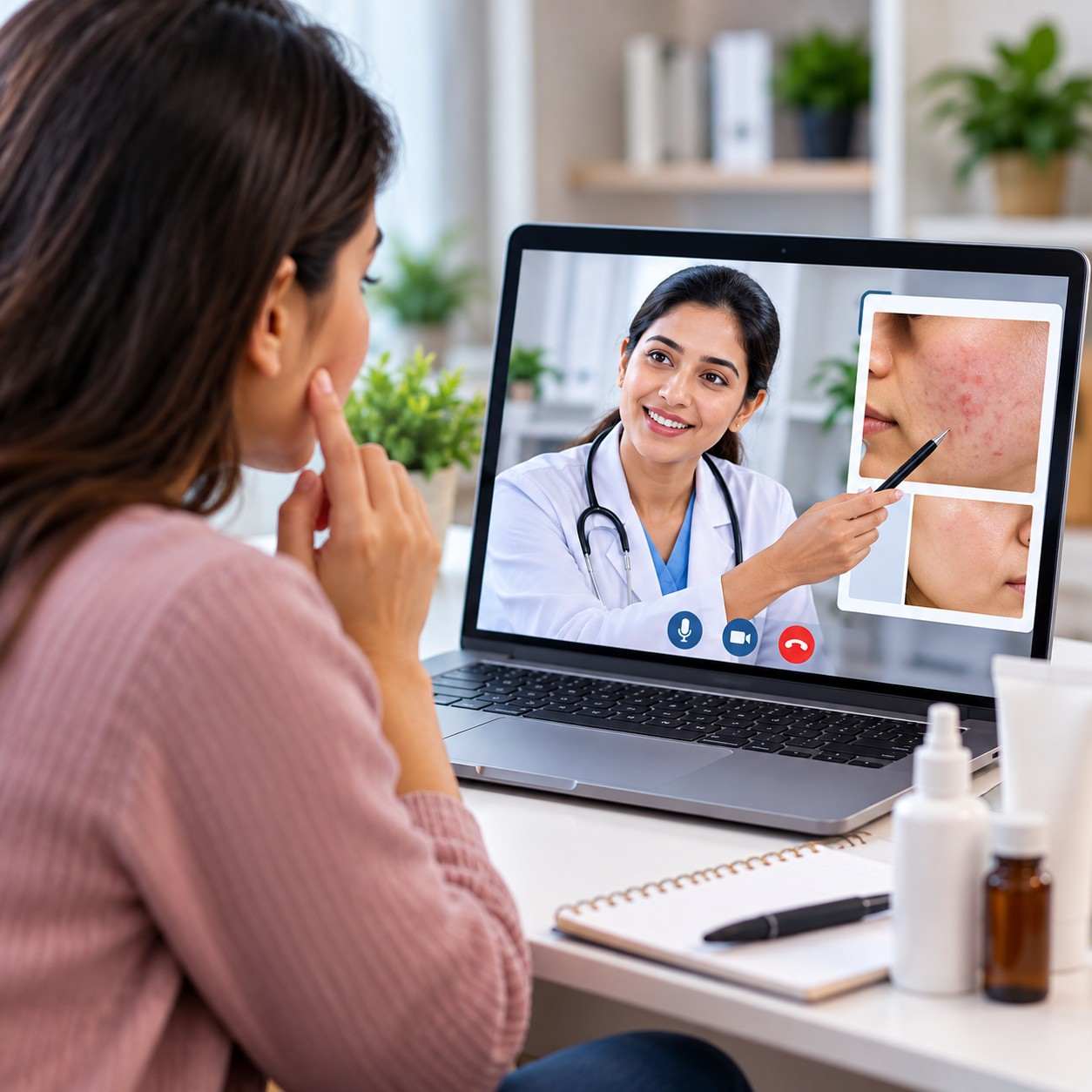



Skin problems can appear suddenly or develop gradually, and finding the right doctor is not always convenient. An online doctor for skin problems can provide a convenient way to discuss visible skin, hair, and nail concerns through video, phone, or secure photo-based consultations.
Online dermatology, also called teledermatology, can be useful for many visible conditions. The American Academy of Dermatology notes that telemedicine can be used for concerns such as acne, eczema, psoriasis, rashes, and some suspicious skin spots, although some conditions still require an in-person examination.
This guide explains how online skin consultations work, what conditions may be suitable, how to prepare photographs, what information to share, how prescriptions and follow-ups may work, how to protect your health information, and when you should seek in-person care.
What Is an Online Doctor for Skin Problems?
An online doctor for skin problems is a licensed healthcare professional who evaluates a skin, hair, or nail concern remotely using a telemedicine platform.
Depending on the service, the consultation may happen through:
- Video consultation
- Telephone consultation
- Secure messaging
- Patient-portal communication
- Secure submission of photographs and medical information
The American Academy of Dermatology explains that telemedicine can allow dermatologists to examine skin, hair, and nail problems remotely and manage some chronic conditions.
An online consultation is different from simply uploading a picture to an automated symptom checker. A medical consultation involves a healthcare professional reviewing your history and symptoms and deciding whether remote care is appropriate.
What Skin Problems Can Be Discussed Online?
Online dermatology can be particularly useful for conditions that are visible and can be assessed through photographs or video.
Examples include:
- Acne and breakouts
- Eczema and dermatitis
- Psoriasis
- Common rashes
- Rosacea
- Skin irritation
- Certain fungal-looking rashes
- Dry or flaky skin
- Pigmentation concerns
- Some allergic skin reactions
- Hair and scalp concerns
- Nail changes
- Follow-up of an already diagnosed skin condition
The American Academy of Dermatology identifies rashes, acne, eczema, psoriasis, and some suspicious spots as conditions that may be suitable for telemedicine. citeturn0search0
Whether your particular problem can be managed remotely depends on its appearance, severity, medical history, and the clinician’s assessment.
When Is an Online Dermatologist a Good Option?
Online care may be useful when:
- You live far from a dermatology clinic.
- Getting an appointment in person is difficult.
- You need advice about a visible skin concern.
- You need follow-up for an existing condition.
- You want to discuss treatment progress.
- You need help deciding whether an in-person appointment is necessary.
- You need convenient access to a dermatologist from home.
Telemedicine can also make follow-up easier when a condition needs ongoing management. The AAD notes that chronic conditions such as eczema and psoriasis may be managed through telemedicine when appropriate. citeturn0search0
Online Dermatologist vs. Skin-Care App
A major difference is that an online dermatologist is a healthcare professional, while a skin-care app may simply provide automated information or recommendations.
A dermatologist can consider:
- Your symptoms
- Duration of the problem
- Previous treatments
- Medications
- Allergies
- Medical history
- Photographs
- Changes over time
Automated tools may produce possible conditions without a clinician confirming the result. The AAD warns that diagnostic skin apps and online symptom checkers can be inaccurate, and an incorrect diagnosis can delay appropriate care. citeturn0search2
For a persistent or concerning skin problem, an app should not replace professional medical evaluation.
How Does an Online Skin Consultation Work?
The exact process differs between services, but a typical online dermatology consultation may follow these stages:
- Select an appropriate healthcare service.
- Provide your basic information.
- Describe the skin concern.
- Upload clear photographs if requested.
- Share relevant medical history.
- List current medications and allergies.
- Complete a video, phone, or secure-message consultation.
- Receive the clinician’s assessment and treatment recommendations.
- Follow any instructions for monitoring or follow-up.
- Attend an in-person appointment if the clinician recommends one.
A quality telemedicine service should provide an appropriate way to share medical history and, when necessary, arrange in-person follow-up.
How to Choose an Online Dermatologist
Choosing the first available online service is not always the best approach. Look for a provider who is properly licensed and whose qualifications are clearly displayed.
Consider:
- Dermatology qualifications
- Medical licensing
- Experience with your type of concern
- Secure photo and messaging options
- Clear consultation fees
- Prescription policies
- Follow-up availability
- Access to in-person care when needed
- Privacy and data-security information
- A clear way to obtain your consultation record
The American Academy of Dermatology recommends checking who will actually evaluate you and asking about the provider’s credentials.
What Information Should You Give an Online Skin Doctor?
The more relevant information your doctor has, the easier it may be to understand your concern.
Before the consultation, prepare:
- When the problem started
- Where it appeared first
- Whether it is spreading
- Whether it itches, burns, hurts, flakes, bleeds, or changes
- Products recently used on the area
- Medicines currently being taken
- Previous treatments
- Known allergies
- Relevant medical conditions
- Previous skin problems
- Whether anyone else has similar symptoms
- What seems to make the condition better or worse
The AAD recommends preparing information about medications, previous skin problems, allergies, major medical history, and when symptoms began.
How to Take Photos for an Online Dermatology Appointment
Good photographs can make a remote skin consultation more useful.
For clearer images:
- Use good natural or bright lighting.
- Keep the camera steady.
- Take a wider photo to show location.
- Take a closer photo to show the details.
- Photograph multiple affected areas when relevant.
- Keep the skin clearly visible.
- Avoid filters and beauty modes.
- Follow the clinic’s instructions for uploading images.
- Take new photographs rather than relying only on old pictures when the condition has changed.
The AAD recommends multiple well-lit photographs and advises removing makeup or nail polish from areas that need examination.
What Should You Avoid Before Sending Skin Photos?
Try not to change the appearance of the affected area immediately before photographing it.
Depending on the situation, avoid:
- Picking or scratching the area
- Applying heavy makeup
- Applying a new cosmetic product
- Using filters
- Taking photographs in poor lighting
- Photographing only from very close range
- Hiding important areas of the rash or lesion
The AAD also recommends avoiding actions that may alter the appearance of the skin before an online appointment, such as rubbing or picking the area.
Can an Online Doctor Diagnose Skin Conditions?
An online dermatologist may be able to diagnose or manage some skin conditions remotely, particularly when the condition is clearly visible and the available history and photographs are sufficient.
However, remote assessment has limits. Some conditions may look similar to one another, and some problems require physical examination, testing, biopsy, cultures, or other procedures.
For example, a suspicious mole or skin spot may need an in-person examination and possibly testing or removal. The AAD specifically notes that telemedicine cannot always replace an in-person dermatology visit.
A responsible online doctor should tell you when remote evaluation is insufficient.
Can an Online Dermatologist Prescribe Medication?
Depending on the clinician’s assessment, local prescribing rules, and the medical condition, an online dermatologist may be able to prescribe medication.
The prescription decision should be based on the medical evaluation rather than simply on a patient’s request for a particular product.
Before starting any prescription treatment, make sure you understand:
- How to use it
- How often to use it
- Possible side effects
- Important precautions
- How long treatment is expected to take
- When follow-up is needed
- What to do if symptoms become worse
The AAD notes that dermatology telemedicine can include prescribing medication when necessary.
Online Treatment for Acne
Acne is one of the common skin concerns discussed through teledermatology. A clinician may evaluate the type and severity of acne, ask about previous treatments, and recommend an appropriate plan.
The AAD notes that acne has different forms, including blackheads, whiteheads, pimples, cysts, and nodules, so treatment is not necessarily one-size-fits-all.
If acne is severe, painful, scarring, rapidly worsening, or not improving with treatment, an in-person dermatology evaluation may be appropriate.
Online Care for Eczema and Dermatitis
Eczema and dermatitis can often be assessed remotely because changes such as redness, dryness, scaling, and irritation can be visible.
During an online appointment, the clinician may ask about:
- New soaps or detergents
- Cosmetics
- Skin-care products
- Occupational exposure
- Itching
- Previous episodes
- Areas affected
- Treatment already tried
The AAD notes that eczema and other inflammatory skin conditions can sometimes be managed through telemedicine.
Online Consultation for Psoriasis
People with known psoriasis may use online dermatology for treatment follow-up and monitoring. The dermatologist may review affected areas, symptoms, medications, and changes since the previous visit.
However, new or unusual symptoms may require a more complete evaluation. Psoriasis can affect the skin, scalp, and nails, and may be associated with joint symptoms, which should be discussed with a healthcare professional.
Online Help for Rashes
A rash can have many possible causes, including irritation, allergy, infection, inflammatory conditions, and other medical problems.
An online consultation may be helpful when the rash is visible and the clinician can obtain enough information to assess it. The AAD lists rashes among conditions that can often be evaluated through telemedicine.
Do not assume every rash is minor. A rapidly changing, severe, painful, blistering, or otherwise concerning rash may require prompt in-person medical evaluation.
Can Hair and Nail Problems Be Treated Online?
Some hair and nail concerns can be discussed through teledermatology. Photographs and a detailed history can help the clinician understand visible changes.
However, some hair and nail disorders require examination or testing to identify the underlying cause. Share clear photographs and mention how long the problem has been present, whether it is changing, and any associated symptoms.
Online Dermatology for Skin Pigmentation
Changes in skin pigmentation can have many causes. An online consultation may help a dermatologist review the appearance, distribution, duration, and progression of the change.
Clear photographs and information about recent skin products, sun exposure, medications, inflammation, or previous skin injury can be useful.
If a pigmented area is changing rapidly, bleeding, developing unusual features, or otherwise concerning, an in-person examination may be necessary.
When Online Skin Care May Not Be Enough
Remote care has limitations. An online dermatologist may recommend an in-person visit when:
- A lesion needs physical examination.
- A biopsy may be necessary.
- A procedure is required.
- A suspicious mole needs closer evaluation.
- The diagnosis remains uncertain.
- Symptoms are severe or rapidly worsening.
- There are signs of significant infection.
- Testing is needed.
- Treatment requires a procedure that cannot be performed remotely.
A quality online service should have a pathway for in-person follow-up when required.
Skin Symptoms That Need Prompt Medical Attention
Do not rely only on an online consultation when you have a serious or rapidly developing problem.
Seek appropriate urgent or emergency medical care for symptoms such as:
- Trouble breathing or swallowing with a widespread allergic reaction
- Rapid swelling of the face, lips, or tongue
- Severe skin pain with rapidly spreading redness
- Extensive blistering or peeling
- Severe burns
- A rapidly worsening infection with systemic symptoms
- A serious injury involving the skin
- A rapidly changing suspicious lesion
The appropriate level of care depends on the symptoms and their severity.
How Much Does an Online Dermatologist Cost?
The price of online dermatology varies by provider, location, consultation type, insurance, and whether follow-up or prescription services are included.
Before booking, check:
- Consultation fee
- Follow-up charges
- Prescription-related costs
- Whether insurance is accepted
- Refund or cancellation rules
- Whether in-person follow-up is included or billed separately
Avoid choosing a service solely because it is the cheapest option. The provider’s qualifications, security practices, and clinical process also matter.
Can Online Dermatology Save Time?
One of the main advantages of teledermatology is convenience. You may not need to travel to a clinic for every consultation, especially when the problem can be evaluated remotely.
Online care can be particularly useful for:
- Initial assessment of suitable visible conditions
- Follow-up appointments
- Treatment monitoring
- Questions about an existing diagnosis
- People who have difficulty traveling
- People living far from specialist care
The AAD describes telemedicine as a way to access dermatologic care when patients cannot easily reach an office.
What Happens After an Online Dermatology Consultation?
Follow-up is an important part of skin care.
After the consultation:
- Follow the treatment instructions carefully.
- Record changes in your symptoms.
- Take progress photographs when requested.
- Report significant side effects.
- Attend recommended follow-up appointments.
- Arrange an in-person assessment if advised.
- Keep a copy of your consultation information.
The AAD recommends asking how follow-up will occur and keeping future telemedicine or in-person appointments recommended by the dermatologist.
Online Dermatologist for Skin Problems: Benefits
Potential benefits include:
- Convenience from home
- Reduced travel
- Easier access to specialists
- Flexible communication options
- Useful photo-based assessment for visible conditions
- Convenient follow-up
- Easier monitoring of some chronic conditions
- Access to care for people in remote areas
Telemedicine is not a replacement for every dermatology visit, but it can be a useful part of modern skin care when used appropriately.
Limitations of Online Skin Consultations
Online dermatology also has limitations:
- Image quality can affect assessment.
- Some conditions look similar.
- Physical examination may be necessary.
- Biopsy or laboratory testing cannot be completed through a standard video visit.
- Some procedures require an in-person clinic.
- A clinician may need to examine a lesion directly.
- Not every skin problem can be safely managed remotely.
A good service should recognize these limitations rather than attempting to manage every condition online.
FAQs
Q. Can I talk to a dermatologist online?
Yes. Teledermatology can use video, telephone, secure messaging, or photographs depending on the service and the condition.
Q. Is an online dermatologist a real doctor?
An online dermatology service may connect you with a licensed dermatologist or another qualified medical professional. Check the provider’s credentials before booking.
Q. Can a dermatologist diagnose acne online?
Acne is among the visible skin conditions that may be suitable for telemedicine, although the clinician decides whether remote assessment is sufficient.
Q. Can I send a photo of my skin to a dermatologist?
Many teledermatology services allow secure photograph submission. Use the clinic’s recommended secure method rather than an unverified platform.
Q. Can an online doctor prescribe skin medicine?
A clinician may prescribe when appropriate and legally permitted after evaluation. Prescribing depends on the provider, the condition, and applicable rules.




Reviews
There are no reviews yet.