![Real Doctors Note For Work and School [Get in 5 Minutes]](https://realdoctorsnotes.com/wordpress/wp-content/webp-express/webp-images/uploads/2025/11/2.png.webp)

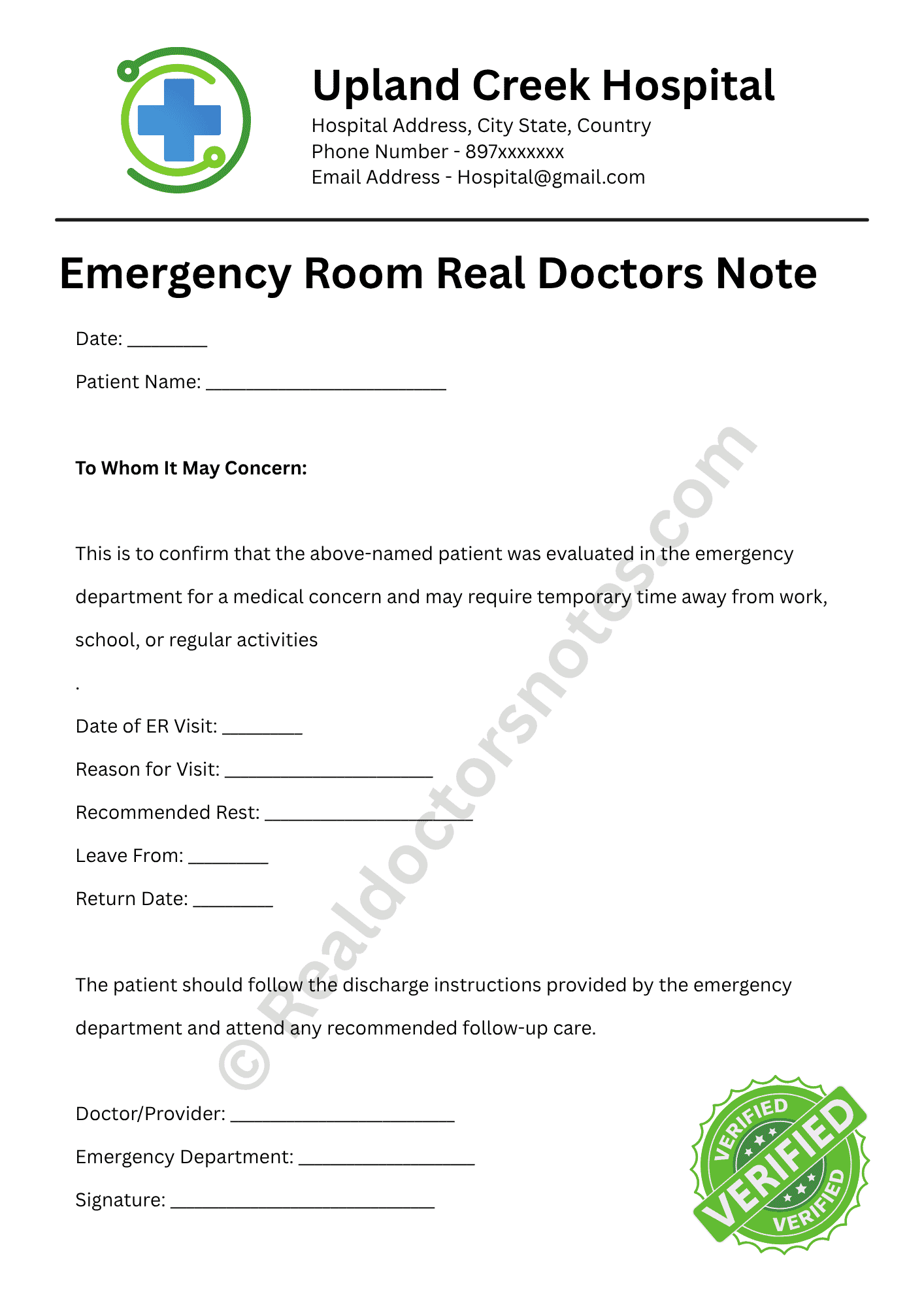


An Emergency Room Real Doctor’s Note is medical documentation provided by a healthcare professional after a patient has been evaluated or treated in an emergency department. Depending on the situation, the documentation may confirm that the patient was seen, describe relevant medical restrictions, or recommend time away from work, school, travel, or other activities.
An emergency department visit is normally documented as part of the patient’s medical record. Emergency records can contain information such as the reason for the visit, clinical findings, tests, treatment, diagnostic impression, and the patient’s disposition after treatment.
However, an ER visit record and a doctor’s note are not always the same document. A patient may receive discharge paperwork or an after-visit summary without automatically receiving a separate work or school excuse. If specific documentation is required, the patient should ask the emergency department or the appropriate medical-records department.
What Is an Emergency Room Doctor’s Note?
An emergency room doctor’s note is written documentation associated with an evaluation or treatment received in an emergency department.
It may be used to communicate medically relevant information to an employer, school, organization, insurer, or another authorized party. The exact information included depends on the patient’s circumstances and the healthcare professional’s assessment.
A legitimate medical note should be based on an actual healthcare encounter. It should not falsely claim that someone was examined, diagnosed, treated, or restricted from activities when that did not happen.
Medical documentation is intended to accurately record what occurred during a healthcare encounter. Government and healthcare guidance emphasizes that medical records should document the patient, the reason for attendance, care provided, findings, treatment, and outcome.
What Information Can an Emergency Room Note Include?
The exact format varies between hospitals and healthcare systems, but emergency documentation may include:
- Patient identification information
- Date and time of the emergency visit
- Reason for seeking emergency care
- Relevant medical history
- Symptoms and clinical observations
- Physical examination findings
- Diagnostic tests or procedures
- Treatment provided
- Diagnosis or diagnostic impression
- Medications or treatment instructions
- Follow-up recommendations
- Activity or work restrictions, when medically appropriate
- Discharge or admission information
- Healthcare professional’s identification and credentials
Emergency medical records commonly document the presenting problem, care received, clinical observations, investigations, diagnostic impression, treatment, and disposition.
Is an ER Visit Record the Same as a Doctor’s Note?
No. This distinction is important.
An emergency room medical record is the broader clinical record created during the patient’s visit. It can contain detailed information about evaluation, testing, treatment, and discharge.
A doctor’s note is generally a more focused piece of documentation prepared for a particular purpose, such as confirming that a patient was evaluated or explaining medically appropriate restrictions.
For example, an emergency department may provide:
- An after-visit summary
- Discharge instructions
- A medical record
- A diagnosis or treatment summary
- A work or school excuse
- A separate medical certificate or letter
Not every patient receives all of these documents automatically.
Can the ER Give You a Doctor’s Note for Work?
An emergency department may provide documentation relating to your visit and, when clinically appropriate, information about temporary work restrictions or time away from work.
Whether a separate work note is issued depends on the healthcare facility, the treating clinician, the patient’s medical circumstances, and the employer’s documentation requirements.
If you need a work note, it is best to request it before leaving the emergency department. Explain what documentation your employer requires and ask whether the clinician can provide it.
A work note should reflect the clinician’s actual assessment. It should not be used to request restrictions that are medically unsupported.
Can an ER Doctor’s Note Excuse You From Work?
It can potentially document medically recommended absence or restrictions, but the final acceptance of a note can depend on the employer’s policy.
For example, a healthcare professional may determine that a patient should:
- Remain away from work for a specified period
- Return to work on a particular date
- Avoid certain physical activities
- Work with temporary restrictions
- Follow up with another healthcare provider
The note should communicate only information that is appropriate and supported by the clinical assessment.
If an employer requires a particular form, ask whether that form needs to be completed instead of relying on a generic doctor’s note.
Can You Get an Emergency Room Note for School?
An ER visit can also result in documentation relevant to a school absence.
Students or parents may ask the emergency department whether documentation can be provided confirming the emergency visit or medically recommended absence.
School policies differ considerably. Some schools may accept an emergency department discharge document, while others may require a specific medical note or additional information.
Before requesting documentation, check the school’s attendance policy so you know exactly what is required.
What If You Forgot to Ask for an ER Doctor’s Note?
You may still be able to request documentation after leaving the emergency department.
Start by contacting the hospital’s medical records department, patient records office, or the emergency department’s administrative staff. Depending on the facility, you may be able to request copies of records or ask whether a clinician can provide appropriate documentation.
Hospitals maintain medical records containing information about patient encounters, and patients may have rights to access their records depending on applicable laws and policies.
The process can vary, so contact the hospital where you were treated rather than assuming every emergency department follows the same procedure.
Can You Get an ER Doctor’s Note After Discharge?
Possibly. The hospital may be able to provide copies of existing medical documentation after discharge.
However, there is an important difference between obtaining an existing record and asking a clinician to create a new certification.
For example, you may be able to obtain:
- Emergency department visit records
- Discharge paperwork
- Test results
- Treatment information
- Diagnosis information
- Existing work or school documentation
A request for a new note covering additional days may require clinical review. A healthcare professional should not certify information that is unsupported by the patient’s medical record or evaluation.
What Makes an Emergency Room Doctor’s Note Legitimate?
A legitimate medical note should correspond to a real healthcare encounter and contain accurate information.
Depending on the type of document and jurisdiction, important elements may include:
- Patient identification
- Date of evaluation
- Healthcare facility information
- Relevant clinical information
- Medical recommendation or restriction
- Healthcare professional’s name
- Professional credentials or registration information where applicable
- Signature or appropriate electronic authentication
- Date of issuance
Medical certification requirements differ by jurisdiction and healthcare organization. In India, for example, the National Medical Commission’s published ethics regulations address medical certificates, including identification details, record-keeping, and the physician’s registration number on certificates and prescriptions.
For this reason, a random internet template should not be presented as if it were an authentic hospital-issued medical document.
How Can You Request a Real ER Doctor’s Note?
If you were actually treated in an emergency department, the simplest approach is to contact the hospital and ask what documentation is available.
Step 1: Identify the hospital
Find the emergency department or hospital where you received treatment.
Step 2: Ask for the correct department
You may need the medical records department, emergency department, patient services department, or discharge office.
Step 3: Explain what you need
Tell the hospital whether you need:
- Proof of an ER visit
- A work excuse
- School absence documentation
- Activity restrictions
- A copy of your medical record
- Discharge documentation
Step 4: Provide required identification
The facility may require information to verify your identity before releasing medical records.
Step 5: Follow the hospital’s request process
Some facilities may provide records electronically, while others may require a written request or identity verification.
What Should You Tell Your Doctor When Requesting a Work Note?
Be specific about the documentation you need.
Instead of simply saying, “I need a doctor’s note,” explain:
- The date you visited the ER
- Whether you missed work
- Whether you need a return-to-work date
- Whether your employer requires restrictions
- Whether your employer has a specific form
- Whether you need documentation for a particular absence
This helps the healthcare professional determine what documentation is appropriate.
Can an ER Note Include Your Diagnosis?
It may, but a work or school note does not necessarily need to disclose detailed medical information.
The appropriate amount of information depends on the purpose of the document, the patient’s privacy, applicable law, and the organization’s requirements.
If your employer only needs confirmation that you were medically evaluated and information about your ability to work, you can ask the healthcare provider what minimum information is appropriate.
Patient medical information is generally treated as confidential, and healthcare systems have procedures governing access to clinical records.
Does an ER Doctor’s Note Guarantee Excused Absence?
No.
A doctor’s note provides medical documentation, but the organization receiving it may have its own attendance requirements.
For example, an employer may have a policy regarding:
- How many days of absence require documentation
- When documentation must be submitted
- Whether a specific form is required
- Whether restrictions can be accommodated
- Whether additional documentation is necessary
Similarly, schools, colleges, airlines, insurers, and other organizations can have their own policies.
What If the ER Did Not Give You a Work Note?
Do not assume that the lack of a separate note means there is no documentation of your visit.
Your hospital may have other records, such as discharge instructions or an emergency visit record. Ask the facility what documents are available and whether a separate work note can appropriately be issued.
The hospital’s medical-records department is often the appropriate place to start when you need copies of existing records.
Can an Online Doctor Replace an Emergency Room Note?
An online healthcare visit and an emergency department visit are different types of medical encounters.
An online clinician can only document an evaluation that actually occurred through that service. They should not create documentation claiming that a patient attended an emergency room when the patient did not.
If you genuinely visited an ER, documentation relating to that visit should generally come from the hospital or healthcare professional involved in that encounter.
Why You Should Avoid Fake Emergency Room Notes
A fake ER note can create serious problems because it falsely represents medical care that may never have occurred.
Submitting fabricated medical documentation to an employer, school, insurer, government agency, court, or another organization can have consequences that vary according to the circumstances and applicable laws.
A safer approach is to obtain genuine documentation from the healthcare facility that actually evaluated you.
Healthcare professionals are expected to maintain accurate records and should not be asked to certify incorrect information.
Emergency Room Note vs. Discharge Paperwork
These documents can serve different purposes.
| Document | Main Purpose |
|---|---|
| ER Medical Record | Detailed clinical documentation of the encounter |
| Discharge Instructions | Explains treatment, precautions, medications, and follow-up |
| After-Visit Summary | Provides a patient-friendly summary of the visit |
| Work Note | Documents work-related restrictions or absence when medically appropriate |
| School Note | Documents medically supported school absence or restrictions |
| Medical Certificate | Formal medical certification where applicable |
The terminology and documents available differ from one healthcare organization to another.
How Long Should an ER Doctor’s Note Excuse You?
There is no universal number of days.
The appropriate duration depends on the patient’s condition, treatment, recovery needs, job duties, and clinical assessment.
A person with a physically demanding job may have different restrictions from someone whose work is primarily sedentary. Similarly, the recommended absence after a minor condition can differ significantly from that following an injury or procedure.
The clinician should determine medically appropriate restrictions rather than issuing a predetermined number of days simply because a patient requests it.
Can an ER Doctor Backdate a Doctor’s Note?
Backdating medical documentation can create accuracy and compliance concerns.
If you genuinely received treatment on an earlier date, the medical record should accurately reflect that encounter. If you need documentation for a past visit, ask the hospital whether it can provide an existing record or appropriately document the previous encounter.
Do not ask a healthcare professional to falsely state that a document was issued or that an evaluation occurred on a date when it did not.
Can You Request Your ER Medical Records?
In many healthcare systems, patients have rights to access their health information, although the exact process and exceptions depend on applicable law.
For example, U.S. HIPAA guidance states that individuals generally have a right to access a broad range of health information maintained by covered healthcare providers, including medical records and clinical test reports, subject to limited exceptions.
If you are requesting records from a particular hospital, follow that hospital’s medical-records procedure.
What If Your Employer Wants More Information?
Ask the employer exactly what is required.
For example, they may need only:
- Confirmation of the visit
- Dates you were unable to work
- A return-to-work date
- Temporary restrictions
- A completed employer form
You can then ask the healthcare facility whether it can provide the requested documentation.
Avoid unnecessarily sharing detailed medical information if the employer does not require it.
FAQs
Q. Can an emergency room give you a doctor’s note?
Yes, an emergency department may provide appropriate documentation relating to a genuine medical evaluation. Whether a separate work or school note is available depends on the facility and clinician.
Q. Can I get a doctor’s note from the ER for one day?
Potentially. The healthcare professional determines whether time away from work or school is medically appropriate and what dates should be documented.
Q. Can I get an ER note after I leave the hospital?
You may be able to obtain existing medical records or discharge documentation after leaving. Contact the hospital’s medical records or patient services department.
Q. Does an ER discharge paper count as a doctor’s note?
Not necessarily. Discharge paperwork documents the emergency visit and instructions, but an employer or school may specifically require a doctor’s note.
Q. Can an ER doctor write a return-to-work note?
When medically appropriate, an emergency clinician may document a patient’s ability to return to work or any restrictions. The exact format depends on the facility.


Reviews
There are no reviews yet.