![Real Doctors Note For Work and School [Get in 5 Minutes]](https://realdoctorsnotes.com/wordpress/wp-content/webp-express/webp-images/uploads/2025/11/2.png.webp)


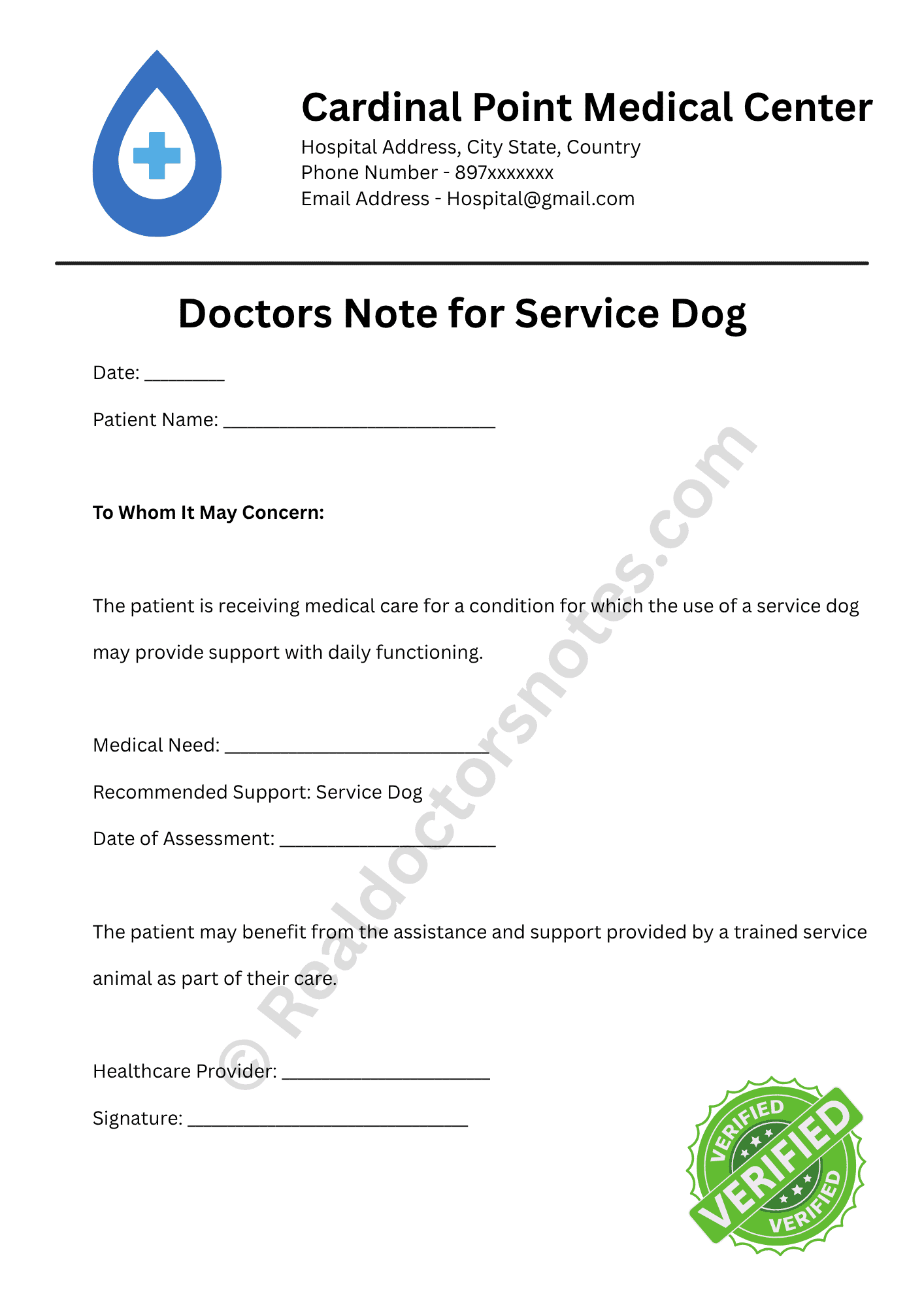




Usually, a doctors note for service dog states disability type or that some other condition has developed, but doesn’t when sensitive information and confirms that “the presence of a service dog is required to assist the person in maintaining a neutral daily activity.”
The note can describe how the service dog helps mitigate the symptoms — through guidance (for example, someone who is visually impaired), alerting to medical episodes, or providing emotional support (in cases of anxiety or PTSD). Such information is useful for gaining accommodations for public spaces, places to work, or a living space so that the person can bring their service dog without bias or hindrance. This is significant in that it normalizes the role of the helper in the therapy it supports understanding and acceptance of the essential duet between a person and their service dog.
What Is a Doctors Note for a Service Dog?
A doctor’s note for a service dog is a medical document written by a licensed healthcare provider after evaluating an individual’s health condition. Rather than serving as a “license” or “registration,” the note explains that the person has a disability or medical condition that may benefit from the assistance of a trained service dog when documentation is appropriate for a specific accommodation request.
A doctor’s note is different from a service dog certification or registration. In the United States, there is no federally recognized certification or registration system required under the ADA for service dogs. Instead, eligibility is based on whether the individual has a qualifying disability and whether the dog has been individually trained to perform tasks directly related to that disability.
A doctor’s note may be useful in situations such as:
- Supporting a housing accommodation request
- Requesting a workplace accommodation
- Providing documentation to a school or university
- Verifying medical necessity when requested under applicable laws
- Assisting with certain administrative or disability-related processes
It is important to remember that not everyone with a service dog will need a doctor’s note, and documentation requirements vary depending on the setting and applicable law.
What Is a Service Dog?
A service dog is a specially trained dog that performs specific tasks to assist a person with a disability. Unlike pets or emotional support animals, service dogs receive specialized training to carry out tasks that directly help mitigate the effects of a disability.
Under the Americans with Disabilities Act (ADA), a service dog is generally defined as a dog individually trained to perform work or tasks for the benefit of a person with a disability.
These tasks must be directly related to the individual’s disability rather than simply providing comfort or companionship.
Examples include:
- Guiding people who are blind
- Alerting individuals who are deaf
- Pulling wheelchairs
- Retrieving dropped objects
- Opening doors
- Detecting seizures
- Alerting to blood sugar changes
- Interrupting panic attacks
- Assisting with balance and mobility
- Reminding individuals to take medication
Because these dogs perform essential tasks, they are legally recognized as working animals rather than pets.
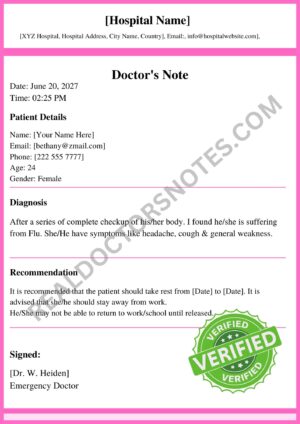
Doctors Note for Service Dog Template
- Verifies Medical Necessity: It supports that the person needs a service dog due to a certain medical or psychological condition, proving that the need for the animal is valid.
- Provides Access Flags: Legally allows the person to bring the service dog into public places, businesses, or residences under disability rights and accommodation laws.
- Assists in Receiving Accommodation Requests: This helps establish that the service dog is necessary for managing the individual’s condition and completing several tasks for them.
- Improves Safety and Independence: Validates that the service dog is a critical resource for the individual: guiding, alerting, or aiding with everyday functions resulting in safer and more autonomous living.
- Share that important information: – Facilitates educating others about the need for a service dog, which builds an environment of understanding and acceptance for both the individual and their service animal.
- Decreases Discrimination: Defends the individual from the risk of being discriminated or refused access because there’s a service dog, and allows them access to different situations.
- Legal Backup: The letter acts as a form of backup for the official documentation of the individual being protected by the rights granted by laws like the Americans with Disabilities Act (ADA), protecting against any challenges or disputes about the service dog.
- Workplace Integration Support: Works with employers to make reasonable adjustments to facilitate the dog’s integration into the workplace, ensuring a seamless transition, and accommodating the individual’s specific needs.
- Ensures Proper Training and Care: One of the primary functions of an emotional support animal letter is to make sure that the person’s emotional support animal has been trained and cared for in a way that will provide the person the emotional assistant they need.
- Health Condition Management ─ Emphasizes the necessity of the service dog for managing the individual’s health condition, enhancing their overall well-being and quality of life
Disabilities That May Qualify for a Service Dog
Many people mistakenly believe that service dogs are only for individuals who are blind. In reality, service dogs assist people with a wide variety of physical, psychiatric, neurological, and medical disabilities.
Physical Disabilities
Individuals with physical disabilities often rely on service dogs for mobility assistance and everyday tasks.
- Blindness
- Low vision
- Hearing impairment
- Paralysis
- Spinal cord injuries
- Multiple sclerosis
- Muscular dystrophy
- Cerebral palsy
- Arthritis
- Parkinson’s disease
- Limb loss or amputation
- Balance disorders
- Chronic mobility limitations
Service dogs can retrieve objects, open doors, assist with transfers, and provide balance support to improve independence.
Medical Conditions
Certain chronic medical conditions may also qualify when a trained service dog performs specific medical alert or response tasks.
Examples include:
- Diabetes
- Epilepsy
- Seizure disorders
- Cardiac conditions
- Syncope (fainting disorders)
- Narcolepsy
- Severe allergies
- Neurological disorders
- Chronic pain disorders
Medical alert dogs may detect changes in blood sugar, warn of seizures, or alert handlers before certain medical emergencies occur.
Mental Health Disabilities
Psychiatric service dogs are trained to perform tasks for individuals with qualifying mental health disabilities.
Conditions may include:
- Post-Traumatic Stress Disorder (PTSD)
- Anxiety disorders
- Panic disorder
- Major depressive disorder
- Autism Spectrum Disorder
- Obsessive-Compulsive Disorder (OCD)
- Bipolar disorder
- Traumatic brain injury
- Schizophrenia (when clinically appropriate)
These dogs perform trained tasks such as interrupting panic attacks, providing grounding techniques, reminding handlers to take medication, and creating physical space during episodes of anxiety.
What Tasks Can a Service Dog Perform?
One of the defining features of a service dog is that it performs specific tasks directly related to its handler’s disability. Simply providing emotional comfort does not qualify a dog as a service animal under the ADA.
Common service dog tasks include:
Mobility Assistance
- Opening doors
- Picking up dropped items
- Carrying medical supplies
- Turning lights on and off
- Helping with balance
- Assisting wheelchair users
- Pulling wheelchairs
- Retrieving phones or emergency devices
Medical Alert Tasks
- Detecting seizures before they occur
- Alerting to low blood sugar
- Alerting to high blood sugar
- Detecting cardiac episodes
- Warning of fainting episodes
- Alerting to severe allergic reactions
Psychiatric Assistance
- Interrupting panic attacks
- Waking someone from nightmares
- Providing deep pressure therapy
- Interrupting self-harming behaviors
- Guiding individuals out of crowded spaces
- Medication reminders
- Grounding during dissociation
- Creating a protective buffer in public
Hearing Assistance
- Alerting to alarms
- Doorbells
- Smoke detectors
- Crying babies
- Emergency sirens
- Someone calling the handler’s name
Vision Assistance
Guide dogs may help individuals:
- Navigate sidewalks
- Avoid obstacles
- Cross intersections safely
- Locate entrances and exits
- Find elevators
- Identify stairs and curbs
These highly trained tasks enable individuals to live more independently and safely.
Who Can Write a Doctor’s Note for a Service Dog?
A doctor’s note for a service dog should come from a licensed healthcare professional who has evaluated the individual’s medical condition and believes documentation is appropriate.
Depending on the person’s disability and the purpose of the documentation, this may include:
- Primary care physician (MD or DO)
- Psychiatrist
- Clinical psychologist
- Nurse practitioner (NP)
- Physician assistant (PA)
- Licensed mental health professional (where appropriate and permitted)
The healthcare provider may assess:
- Medical history
- Current diagnosis
- Functional limitations
- Daily challenges
- How a trained service dog may assist with disability-related tasks
The provider should only issue documentation when it reflects their professional medical judgment based on an appropriate evaluation.
When Might You Need a Doctor’s Note for a Service Dog?
Although a doctor’s note is not generally required for public access under the ADA, there are situations where medical documentation may be requested to support accommodation requests or verify disability-related needs.
Housing Accommodations
Landlords or housing providers may request appropriate documentation in certain situations when the disability or disability-related need is not readily apparent.
Workplace Accommodations
Employees requesting to bring a service dog into the workplace as a reasonable accommodation may need supporting medical documentation as part of the interactive process under employment laws.
Colleges and Universities
Students may be asked to provide documentation when requesting disability accommodations or approval for a service dog in campus housing.
Schools
Primary and secondary schools may have procedures for documenting disability-related accommodation requests while complying with applicable disability laws.
Rehabilitation Programs
Healthcare facilities, rehabilitation centers, or vocational programs may request supporting medical information to plan accommodations.
Government or Disability Assistance Programs
Some administrative processes involving disability accommodations or benefits may require documentation from a licensed healthcare provider.
Understanding when documentation may be appropriate helps individuals prepare the necessary paperwork while protecting their rights.
Situations Where a Doctors Note May Not Be Required
Many people assume they must always carry a doctor’s note with their service dog. In reality, that is not generally required under federal law.
Examples where documentation is typically not required include:
- Entering restaurants
- Shopping at grocery stores
- Visiting retail shops
- Staying at hotels covered by ADA rules
- Using public transportation
- Walking through airports
- Visiting parks
- Going to libraries
- Entering government buildings
- Visiting hospitals (except restricted sterile areas)
Businesses usually cannot require customers to present medical records, certification, identification cards, or a doctor’s note simply because a service dog accompanies them.
However, staff may ask two limited questions when the disability is not obvious:
- Is the dog required because of a disability?
- What work or task has the dog been trained to perform?
They generally cannot ask about the person’s diagnosis or request detailed medical information.
Difference Between a Service Dog, Emotional Support Animal, and Therapy Dog
Many people confuse service dogs with emotional support animals (ESAs) and therapy dogs, but they serve different purposes and are covered by different rules.
| Feature | Service Dog | Emotional Support Animal (ESA) | Therapy Dog |
|---|---|---|---|
| Primary Purpose | Performs specific tasks related to a person’s disability | Provides emotional comfort and companionship | Offers comfort to multiple people in settings like hospitals, schools, and nursing homes |
| Training | Individually trained to perform disability-related tasks | No specialized task training required | Trained for good behavior and therapeutic interactions |
| Legal Protection | Protected under the Americans with Disabilities Act (ADA) for public access | Not granted the same public access rights under the ADA | No ADA public access rights |
| Public Access | Allowed in most public places where the handler is permitted | Generally treated as pets in public places unless another law applies | Access is limited to facilities where they are invited |
| Handler | Assists one person with a qualifying disability | Supports one person emotionally | Works with a handler to benefit many people |
| Medical Documentation | May be requested for certain accommodation situations | Documentation may be requested depending on the accommodation sought | Typically not required |
| Examples of Tasks | Guiding, seizure alerts, mobility assistance, diabetic alerts, psychiatric tasks | Emotional comfort without trained disability-specific tasks | Visiting patients, reducing stress in schools or care facilities |
What Information Is Included in a Doctors Note for a Service Dog?
A service dog doctor’s note should be professional, clear, and focused on the accommodation request. The exact content may vary depending on the provider and the purpose of the documentation, but it often includes:
- Patient’s name
- Date of evaluation
- Date the note was issued
- Healthcare provider’s name
- Professional credentials
- Office or clinic information
- Confirmation that the individual was evaluated
- Statement supporting the need for an accommodation, when appropriate
- Description of relevant functional limitations (without unnecessary medical details)
- Provider’s signature
- License information, if applicable
- Contact information for verification, when appropriate
The note should protect the patient’s privacy while providing enough information to support a legitimate accommodation request.
How Long Is a Doctor’s Note for a Service Dog Valid?
There is no single federal expiration date for a doctor’s note for a service dog. The validity of the documentation depends on the purpose for which it is being used and the policies of the organization reviewing it.
Some accommodation requests may accept documentation that is several months old, while others may ask for more recent medical information if circumstances have changed or if updated documentation is reasonably necessary.
In general, you may be asked to obtain updated documentation if:
- Your medical condition has significantly changed.
- The accommodation request is being renewed.
- The documentation is outdated for the organization’s requirements.
- A healthcare provider recommends a follow-up evaluation.
- Additional medical information is reasonably required to process the request.
If you are unsure whether your documentation is still acceptable, check the specific requirements of the employer, housing provider, school, or other organization requesting it.
Can a Doctor Refuse to Write a Service Dog Note?
Yes. A licensed healthcare provider is not required to issue a doctor’s note simply because a patient requests one.
Healthcare professionals have an ethical and legal responsibility to provide documentation that accurately reflects their professional medical judgment. If, after an evaluation, they determine that a service dog is not medically appropriate or that additional assessment is needed, they may decline to issue the note.
A provider may refuse if:
- There is no qualifying disability.
- The service dog is not medically necessary.
- The evaluation is incomplete.
- Additional testing or specialist consultation is required.
- The request is based on inaccurate or misleading information.
- Issuing the documentation would not align with professional standards.
If a request is denied, consider discussing your concerns with the provider or seeking a second opinion from another qualified healthcare professional when appropriate.
Can You Get a Doctors Note for a Service Dog Online?
In many cases, yes. Telehealth has made it possible for individuals to consult licensed healthcare providers remotely.
During a virtual appointment, the provider may:
- Review your medical history.
- Discuss your symptoms.
- Evaluate your functional limitations.
- Assess whether a trained service dog may help with your disability.
- Decide whether documentation is medically appropriate.
If the provider determines that a doctor’s note is appropriate, they may issue the documentation electronically or through another secure method.
Online consultations can be especially helpful for individuals who have mobility limitations, chronic illnesses, or difficulty traveling to an in-person appointment.
Can a Fake Doctors Note Cause Problems?
Using a fake or altered doctor’s note for a service dog can lead to serious consequences.
Potential risks include:
- Rejection of accommodation requests.
- Loss of trust with employers or housing providers.
- School disciplinary action.
- Employment consequences.
- Possible legal issues if fraudulent documents are knowingly submitted.
- Delays in receiving legitimate accommodations.
Always obtain documentation through a licensed healthcare provider after a proper medical evaluation.
Benefits of Having Proper Medical Documentation
Although a doctor’s note is not required in every situation, having appropriate medical documentation can make certain accommodation processes smoother.
Benefits may include:
- Supporting housing accommodation requests.
- Helping employers understand accommodation needs.
- Assisting colleges and universities with disability services.
- Providing documentation for administrative purposes.
- Demonstrating that a licensed healthcare provider evaluated your condition.
- Reducing misunderstandings during the accommodation process.
- Helping organizations review requests more efficiently.
Medical documentation should always be truthful, accurate, and based on professional clinical judgment.
Common Myths About Service Dogs
Many misconceptions exist about service dogs and medical documentation. Understanding the facts can help individuals protect their rights and avoid confusion.
Myth 1: Every Service Dog Needs a Doctors Note
Fact: A doctor’s note is not generally required for public access under the ADA. Documentation may be useful in certain accommodation situations, such as housing or employment, depending on the circumstances.
Myth 2: Any Dog Can Be a Service Dog
Fact: A service dog must be individually trained to perform specific tasks directly related to a person’s disability. Good behavior alone does not make a dog a service animal.
Myth 3: Emotional Support Animals and Service Dogs Are the Same
Fact: Emotional support animals provide comfort but are not individually trained to perform disability-related tasks in the same way that service dogs are.
Myth 4: Businesses Can Ask for Medical Records
Fact: Businesses generally cannot require customers to disclose their medical diagnosis or provide medical records simply because they are accompanied by a service dog.
Myth 5: Service Dogs Never Make Mistakes
Fact: Even highly trained service dogs are living animals. Proper training, regular practice, and responsible handling are essential to maintain reliable performance.
Myth 6: Only Large Dogs Can Be Service Dogs
Fact: Service dogs come in many sizes and breeds. The most appropriate dog depends on the individual’s disability and the specific tasks the dog is trained to perform.
Responsibilities of a Service Dog Owner
Owning a service dog comes with important responsibilities to ensure the safety of the public and the effectiveness of the partnership.
Handlers should:
- Keep the dog under control at all times.
- Ensure the dog is house-trained.
- Maintain regular veterinary care.
- Provide proper nutrition and exercise.
- Keep vaccinations up to date.
- Use appropriate equipment such as a leash or harness when required.
- Continue reinforcing task training.
- Respect public spaces and clean up after the dog.
- Follow applicable local and federal laws.
A well-trained service dog and a responsible handler help create positive experiences for everyone.
How to Care for a Working Service Dog
A service dog performs demanding daily tasks and requires consistent care to stay healthy and effective.
Important aspects of care include:
- Balanced, nutritious diet.
- Daily exercise.
- Mental stimulation.
- Routine grooming.
- Regular veterinary checkups.
- Dental care.
- Adequate rest.
- Ongoing task practice.
- Positive reinforcement during training.
- Monitoring for signs of illness or stress.
Healthy service dogs are better able to perform their trained tasks reliably.
Can Puppies Be Service Dogs?
Puppies may begin basic obedience and socialization training, but they are generally not considered fully trained service dogs until they have completed advanced task training and can consistently perform disability-related work in public settings.
Training often includes:
- Basic obedience.
- Public access behavior.
- Exposure to different environments.
- Specialized disability-related tasks.
- Reliability under distraction.
The timeline varies depending on the dog, the trainer, and the complexity of the required tasks.
State Laws vs. Federal Laws
Federal laws such as the ADA establish important protections for individuals with service dogs. However, individual states may have additional laws regarding service animals.
State laws may address topics such as:
- Misrepresentation of service animals.
- Public access protections.
- Training standards in certain situations.
- Penalties for interference with service dogs.
- Additional disability rights.
Because laws can vary, it’s helpful to understand both federal protections and the specific rules in your state.
What Should You Do If Someone Denies Access to Your Service Dog?
If you are denied access, remain calm and explain that your dog is a trained service animal.
You can:
- Politely explain your rights under applicable disability laws.
- Answer the two questions businesses are generally permitted to ask, if appropriate.
- Request to speak with a manager.
- Keep records of the incident if necessary.
- Consider contacting the appropriate government agency or disability rights organization if you believe your rights have been violated.
Remaining respectful and informed often helps resolve misunderstandings.
Service Dog Etiquette for the Public
Members of the public should respect the important work service dogs perform.
Good etiquette includes:
- Do not pet a working service dog without permission.
- Do not distract the dog while it is working.
- Avoid feeding the dog.
- Speak to the handler rather than the dog.
- Give the team enough space to move safely.
- Respect the dog’s role as a working animal.
These simple practices help service dogs remain focused on assisting their handlers.
FAQs
1. What is a doctor’s note for a service dog?
It is documentation from a licensed healthcare provider that may support certain disability-related accommodation requests when appropriate.
2. Is a doctor’s note legally required for every service dog?
No. Public access under the ADA generally does not require a doctor’s note, though documentation may be requested in some accommodation contexts.
3. Can I get a doctor’s note for a service dog online?
Yes, if a licensed healthcare provider evaluates you through telehealth and determines that documentation is medically appropriate.
4. Who can write a service dog doctor’s note?
Depending on the situation, it may be written by a physician, psychiatrist, psychologist, nurse practitioner, physician assistant, or another qualified licensed healthcare professional.
5. Can anxiety qualify for a service dog?
In some cases, individuals with qualifying anxiety disorders may benefit from a psychiatric service dog that performs trained tasks related to their disability.






Reviews
There are no reviews yet.